
Nous aurons le plaisir d’accueillir Ali Batikh, Chercheur post-doctoral, Université de Bordeaux. Il vous sera possible de participer à son séminaire le Lundi 09 février 2026 à 14h à l’Institut de Psychologie en salle 1046.

Saccadic adaptation: cross-modal transfer, effect of spatial attention, and effect of action semantics
Saccadic eye movements maintain accuracy through saccadic adaptation (SA), a plasticity-based mechanism that has been extensively studied in the visual domain. Whether similar adaptive processes apply to non-visual saccades elicited by tactile or auditory stimuli has remained largely unexplored. In a first set of studies, we investigated whether reactive saccades toward tactile (Study 1) and auditory targets (Study 2) can be adapted using the double target step paradigm, and whether such adaptation transfers across sensory modalities. Our results show that tactile and auditory saccades adapt in a manner comparable to visual saccades. However, adaptation transfer was asymmetric: visual SA fully generalized to tactile and auditory saccades, whereas tactile and auditory SA transferred only partially to visual saccades. This pattern supports a motor-level locus of adaptation for visual saccades and suggests additional, modality-specific adaptation loci upstream of the final common motor pathway for non-visual saccades. Importantly, both studies demonstrated that SA can be elicited in complete darkness, without post-saccadic visual feedback, challenging current error signals models. Given the close functional and neural links between spatial attention and saccadic orienting, spatial attention emerges as a potential contributor to saccadic error processing. In a second part (Study 3), we directly tested the modulatory role of spatial attention on SA by combining saccadic adaptation with cross-modal attentional-orienting paradigms. We found significant correlations between the magnitude and time course of adaptation and the allocation of spatial attention relative to the adapted target. These findings support a functional coupling between spatial attention and SA, possibly mediated by attentional modulation of saccadic error signals at the level of the posterior parietal cortex. The flexibility of SA is illustrated by contextual saccadic adaptation, whereby the oculomotor system can concurrently maintain two opposing adaptations for the same saccade vector, provided that each adaptation is consistently paired with a distinct contextual cue. In a complementary line of research (Study 4), we examined whether action semantics, defined as multimodal object representations, can serve as contextual cues for SA. Specifically, we tested whether motor representations associated with objects could enable the saccadic system to predict the location of an upcoming saccade target. Our results did not reveal evidence for such an effect. At present, however, the conditions under which contextual cues effectively support saccadic adaptation remain insufficiently defined, making it premature to draw firm conclusions regarding the role of action semantics. Further research is therefore required to clarify the mechanisms and constraints of contextual saccadic adaptation.
Accès
Le séminaire se déroulera le 09 février 2026 à 14h en salle 1046 à l’Institut de Psychologie au 71 avenue Edouard Vaillant, 92100 Boulogne-Billancourt.
L’accès au bâtiment est contrôlé. Il sera donc nécessaire de vous inscrire si vous n’avez pas de carte d’accès Université Paris Cité. Contactez le secretariat-vac.psycho@u-paris.fr pour toute information ou pour vous inscrire.
Access
The seminar will take place on 9th febuary at 14:00 in room 1046 at “Institut de Psychologie”, 71 avenue Edouard Vaillant, 92100 Boulogne-Billancourt.
The security guard will check your identity. You will need to register to access to the seminar if you do not have a Université Paris Cité’s access card. Please contact secretariat-vac.psycho@u-paris.fr for registration or if you need further information.
À lire aussi
Demi-journée scientifique du 12 juin
Le vendredi 12 juin 2026, le laboratoire a organisé une matinée scientifique consacrée aux projets menés par les stagiaires accueillis cette année. Au programme, des présentations orales et une session posters permettant de découvrir, dans une ambiance conviviale, des...
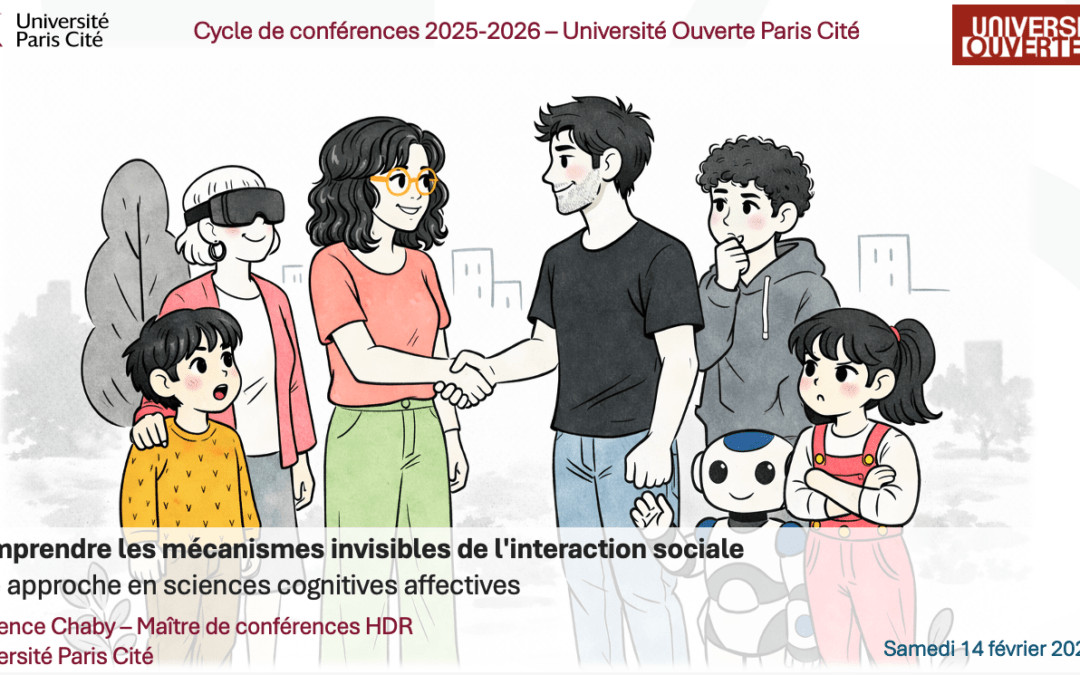
Université Ouverte 2026
Dans le cadre du programme de l’Université Ouverte de l’Université Paris Cité, Laurence Chaby, maître de conférences en psychologie cognitive au laboratoire Vision Action Cognition, interviendra le samedi 14 février 2026 lors d’une conférence intitulée « Comprendre...

Le laboratoire VAC fête la fin d’année
À l’issue du conseil de laboratoire qui s’est tenu ce mardi 15 décembre, les membres du laboratoire Vision Action Cognition se sont retrouvés pour fêter la fin d’année autour d’un repas convivial, placé cette année sous le thème des îles. Ce moment festif, organisé...
![[Archive][08/12/25] Laurie Geers](https://vac.u-paris.fr/wp-content/uploads/sites/11/2022/02/Seminaires-pexels-luis-quintero-2774556-1080x675.jpg)
[Archive][08/12/25] Laurie Geers
Nous aurons le plaisir d’accueillir Laurie GEERS, Chargée de recherche FNRS, Université catholique Louvain, Belgique. Il vous sera possible de participer à son séminaire le Lundi 08 décembre 2025 à 14h à l’Institut de Psychologie.Does the brain see double? The effect...